ANAVEM
Languagefr
Windows Services management console displaying service status and Event Viewer on professional monitoring setup
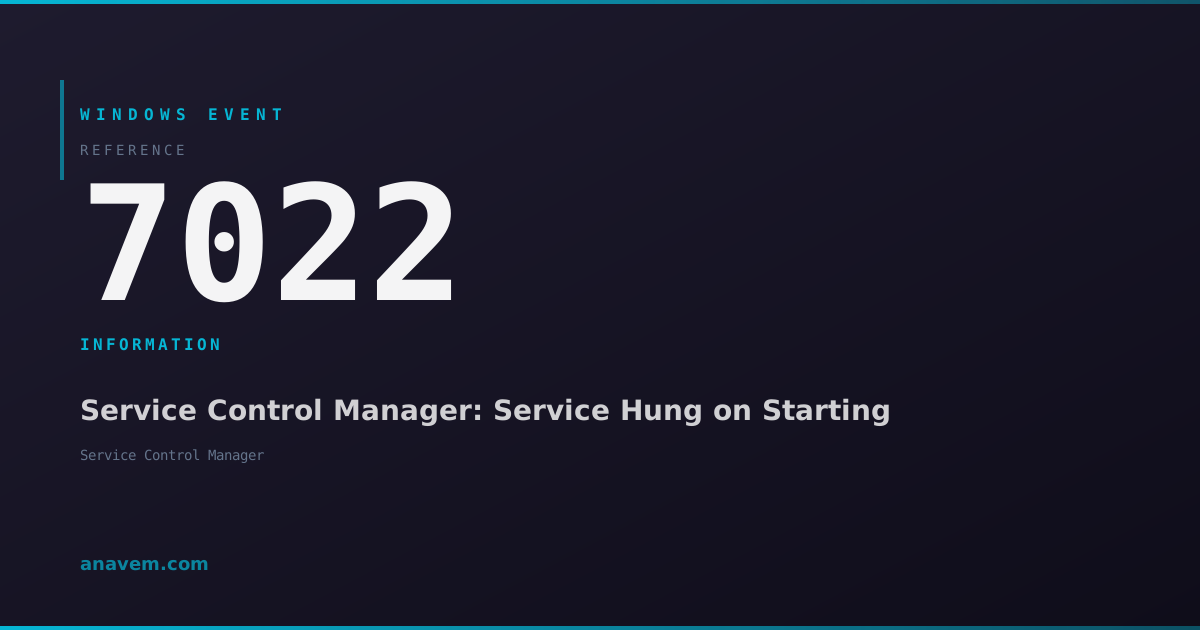
Event ID 7022ErrorService Control ManagerWindows

Windows Event ID 7022 – Service Control Manager: Service Hung on Starting

Event ID 7022 indicates a Windows service failed to start within the configured timeout period, causing the Service Control Manager to log this error and potentially affecting system functionality.

Emanuel DE ALMEIDAEmanuel DE ALMEIDA
18 March 202612 min read 0
Event ID 7022Service Control Manager 5 methods 12 min
Event Reference

What This Event Means

Event ID 7022 represents one of the most common service-related errors in Windows environments, particularly affecting enterprise systems with complex service dependencies. The Service Control Manager generates this event when it sends a start request to a service but fails to receive the expected response within the predetermined timeout window.

The underlying mechanism involves the SCM sending a SERVICE_CONTROL_START message to the target service and waiting for a SERVICE_STATUS response indicating successful initialization. When services fail to respond due to resource contention, dependency issues, or internal errors, the SCM logs Event ID 7022 and marks the service as failed.

This event commonly affects services that perform extensive initialization routines, such as database services, antivirus engines, or custom enterprise applications. The timeout behavior is governed by registry settings and can be influenced by system load, disk I/O performance, and network connectivity for services requiring external resources during startup.

In Windows Server 2025 and Windows 11 24H2, Microsoft has enhanced the SCM's diagnostic capabilities, providing more detailed information about service startup failures and improved integration with Windows Error Reporting for better troubleshooting support.

Applies to

Windows 10Windows 11Windows Server 2019/2022/2025
Analysis

Possible Causes

  • Service initialization code contains infinite loops or blocking operations
  • Required dependencies are unavailable or failed to start properly
  • Insufficient system resources (memory, CPU, or disk I/O) during service startup
  • Registry corruption affecting service configuration or dependencies
  • Network connectivity issues for services requiring external resources
  • File system permissions preventing access to required service files
  • Antivirus software blocking or scanning service executables during startup
  • Hardware failures affecting disk access or memory allocation
  • Service executable file corruption or missing dependencies
  • Conflicting services attempting to use the same resources simultaneously
Resolution Methods

Troubleshooting Steps

01

Check Event Viewer for Service Details

Start by identifying the specific service causing the timeout and gathering detailed information from Event Viewer.

  1. Open Event Viewer by pressing Win + R, typing eventvwr.msc, and pressing Enter
  2. Navigate to Windows LogsSystem
  3. Filter for Event ID 7022 by right-clicking SystemFilter Current Log → enter 7022 in Event IDs field
  4. Double-click the most recent Event ID 7022 entry to view details
  5. Note the service name mentioned in the event description
  6. Use PowerShell to get additional service information:
    Get-Service -Name "ServiceName" | Format-List *
    Get-WinEvent -FilterHashtable @{LogName='System'; Id=7022} -MaxEvents 5 | Format-Table TimeCreated, Message -Wrap
  7. Check for related events around the same timestamp that might indicate root causes
Pro tip: Look for Event IDs 7000, 7009, or 7031 occurring near the same time, as these often provide additional context about service failures.
02

Investigate Service Dependencies and Status

Examine the service configuration and dependencies to identify potential startup issues.

  1. Open Services console by running services.msc
  2. Locate the problematic service and double-click to open Properties
  3. Check the Dependencies tab to identify required services
  4. Verify all dependencies are running using PowerShell:
    $serviceName = "YourServiceName"
    $service = Get-Service -Name $serviceName
    $dependencies = Get-Service -Name $serviceName -DependentServices
    $dependencies | Format-Table Name, Status, StartType
  5. Check the service's startup type and account configuration in the General and Log On tabs
  6. Review the service executable path and verify file existence:
    $servicePath = (Get-WmiObject -Class Win32_Service -Filter "Name='$serviceName'").PathName
    Test-Path $servicePath.Split('"')[1]
  7. Attempt manual service startup and monitor for immediate failures
Warning: Do not change service startup types without understanding the impact on system functionality and dependent services.
03

Analyze Service Startup Timeout Configuration

Examine and potentially adjust service timeout settings to resolve startup issues.

  1. Check the current service timeout value in the registry:
    Get-ItemProperty -Path "HKLM:\SYSTEM\CurrentControlSet\Control" -Name "ServicesPipeTimeout"
  2. Open Registry Editor as Administrator and navigate to HKLM\SYSTEM\CurrentControlSet\Control
  3. Look for the ServicesPipeTimeout DWORD value (default is 30000 milliseconds)
  4. Check service-specific timeout settings:
    $serviceName = "YourServiceName"
    $regPath = "HKLM:\SYSTEM\CurrentControlSet\Services\$serviceName"
    Get-ItemProperty -Path $regPath -ErrorAction SilentlyContinue
  5. If the service consistently requires more time to start, consider increasing the timeout:
    # Increase global service timeout to 60 seconds (60000 ms)
    Set-ItemProperty -Path "HKLM:\SYSTEM\CurrentControlSet\Control" -Name "ServicesPipeTimeout" -Value 60000 -Type DWord
  6. Restart the system to apply timeout changes
  7. Monitor subsequent service startups to verify improvement
Pro tip: Before modifying timeout values, investigate why the service requires extended startup time, as this often indicates underlying performance issues.
04

Perform Advanced Service Diagnostics

Use advanced diagnostic tools to identify the root cause of service startup failures.

  1. Enable service control manager debug logging:
    New-ItemProperty -Path "HKLM:\SYSTEM\CurrentControlSet\Control\Session Manager\Debug Print Filter" -Name "DEFAULT" -Value 0xFFFFFFFF -PropertyType DWord -Force
  2. Use Process Monitor (ProcMon) to trace service startup activity:
    • Download ProcMon from Microsoft Sysinternals
    • Set filters for the service executable name
    • Attempt service startup while monitoring file/registry access
  3. Check Windows Error Reporting logs for service crashes:
    Get-WinEvent -FilterHashtable @{LogName='Application'; ProviderName='Windows Error Reporting'} -MaxEvents 10 | Where-Object {$_.Message -like "*YourServiceName*"}
  4. Analyze service dependencies with PowerShell:
    $serviceName = "YourServiceName"
    $service = Get-WmiObject -Class Win32_Service -Filter "Name='$serviceName'"
    $dependencies = $service.ServiceDependencies
    foreach ($dep in $dependencies) {
        $depService = Get-Service -Name $dep
        Write-Output "$dep : $($depService.Status)"
    }
  5. Check system resource utilization during service startup using Performance Monitor
  6. Review Application and System event logs for related errors occurring during the startup timeframe
05

Rebuild Service Configuration and Dependencies

When other methods fail, rebuild the service configuration to resolve persistent startup issues.

  1. Export the current service configuration for backup:
    $serviceName = "YourServiceName"
    $service = Get-WmiObject -Class Win32_Service -Filter "Name='$serviceName'"
    $service | Export-Clixml -Path "C:\Temp\$serviceName-backup.xml"
  2. Stop the problematic service and any dependent services:
    Stop-Service -Name $serviceName -Force
    Get-Service -Name $serviceName -DependentServices | Stop-Service -Force
  3. Remove and recreate the service registration:
    # Note: Only for non-critical system services
    # sc delete $serviceName
    # sc create $serviceName binPath="C:\Path\To\Service.exe" start=auto
  4. Reset service permissions using the Services console or PowerShell:
    $acl = Get-Acl "HKLM:\SYSTEM\CurrentControlSet\Services\$serviceName"
    # Review and reset permissions as needed
  5. Verify service executable integrity:
    $servicePath = (Get-WmiObject -Class Win32_Service -Filter "Name='$serviceName'").PathName
    sfc /scanfile=$servicePath.Split('"')[1]
  6. Restart dependent services in proper order and test functionality
Warning: Service recreation should only be performed on non-critical services and with proper backups. System services require special consideration and may need installation media for repair.

Overview

Event ID 7022 fires when the Windows Service Control Manager (SCM) determines that a service has exceeded its startup timeout period without properly responding. This critical error indicates that a service attempted to start but became unresponsive during the initialization process, forcing the SCM to abandon the startup attempt after waiting for the configured timeout duration.

The event typically appears in the System log and includes the service name that failed to start properly. This can occur during system boot, when manually starting services, or when dependencies trigger service startup. The timeout period varies by service type and system configuration, but generally ranges from 30 seconds to several minutes for complex services.

When this event occurs, the affected service remains in a transitional state and may impact dependent services or system functionality. The SCM will not attempt automatic recovery unless specifically configured, making immediate investigation crucial for maintaining system stability and performance.

Frequently Asked Questions

What does Event ID 7022 mean and why does it occur?+
Event ID 7022 indicates that a Windows service failed to respond to a start request within the configured timeout period. The Service Control Manager logs this error when it sends a start command to a service but doesn't receive the expected response confirming successful initialization. This typically occurs due to service code issues, resource constraints, dependency problems, or system performance bottlenecks that prevent the service from completing its startup routine within the allotted time.
How can I identify which service is causing Event ID 7022?+
The service name is included in the Event ID 7022 message text within Event Viewer. Open Event Viewer, navigate to Windows Logs → System, and filter for Event ID 7022. The event description will explicitly mention the service name that failed to start. You can also use PowerShell to extract this information: Get-WinEvent -FilterHashtable @{LogName='System'; Id=7022} | Select-Object TimeCreated, Message. The message field contains the service name and additional context about the failure.
Is it safe to increase the service timeout value to resolve Event ID 7022?+
Increasing the service timeout can be a temporary solution, but it's not addressing the root cause. While it's generally safe to modify the ServicesPipeTimeout registry value from the default 30 seconds to 60-120 seconds, this should be done cautiously. The timeout increase may mask underlying performance issues, dependency problems, or service code defects that should be properly investigated and resolved. Always document the change and monitor system performance after modification.
Can Event ID 7022 cause system instability or boot failures?+
Yes, Event ID 7022 can cause significant system issues depending on the affected service. If critical system services fail to start, it can lead to boot failures, reduced functionality, or system instability. Services marked as 'Automatic (Delayed Start)' may cause slower boot times, while essential services like Windows Audio, DHCP Client, or security services can severely impact user experience and system security. The severity depends on the service's role and its dependencies on other system components.
What's the difference between Event ID 7022 and other service-related events like 7000 or 7009?+
Event ID 7022 specifically indicates a service startup timeout, while other events represent different failure types. Event ID 7000 indicates a service failed to start due to an error (like missing files or access denied), Event ID 7009 indicates a service startup timeout but with different circumstances, and Event ID 7031 indicates a service terminated unexpectedly. Event ID 7022 is unique because it shows the service attempted to start but became unresponsive during initialization, whereas 7000 shows immediate startup failures with specific error codes.
Documentation

References (2)

Emanuel DE ALMEIDA
Written by

Emanuel DE ALMEIDA

Senior IT Journalist & Cloud Architect

Microsoft MCSA-certified Cloud Architect | Fortinet-focused. I modernize cloud, hybrid & on-prem infrastructure for reliability, security, performance and cost control - sharing field-tested ops & troubleshooting.

Discussion

Share your thoughts and insights

You must be logged in to comment.

Loading comments...